
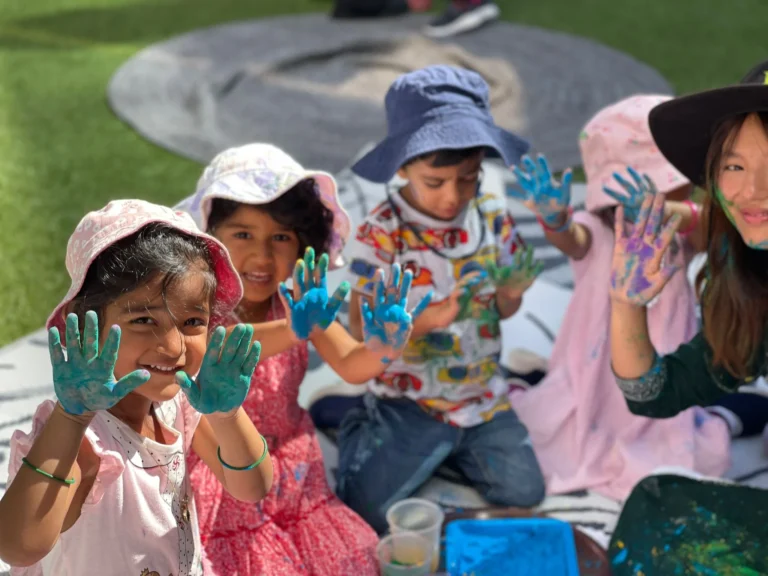
At Reggio Emilia Early Learning Centres, we believe in every child’s extraordinary potential. Central to our philosophy is the “100 Languages of Children,” a transformative idea that shapes our approach to early childhood education. This concept, rooted in the visionary work of Loris Malaguzzi, underscores the many ways children express themselves beyond mere words.
The “100 Languages of Children” refers to the diverse forms of expression children use to communicate their thoughts, emotions, and understanding of the world. Loris Malaguzzi, the founder of the Reggio Emilia Approach, championed the idea that children possess a rich spectrum of expressive languages. This perspective shifts our focus from traditional verbal communication to a more holistic view, recognising and valuing the various ways children interact with their environment. These languages encompass various forms of expression, including but not limited to:
Visual Arts
Children often communicate through visual arts, such as drawing, painting, and sculpting. These mediums allow them to convey feelings, explore concepts, and represent their experiences. For example, a child might create a vibrant painting to express their emotions about a recent event or to explore a new idea they are learning about.
Dramatic Play
Dramatic play is another powerful language. Children express themselves through role-playing, acting out scenarios, and using props to make sense of the world around them. They might reenact a story they have heard or invent their own imaginative narratives, using dramatic play to process and communicate their thoughts.
Movement and Dance
Physical expression through movement and dance is a dynamic way for children to communicate. They might use their bodies to express feelings or ideas, showcasing their creativity through choreographed routines or spontaneous movements. This form of expression is particularly important for children who are more kinesthetically inclined.
Writing and Storytelling
Beyond spoken language, children express themselves through writing and storytelling. They create their own stories, write letters, or keep journals, using these written forms to convey their inner worlds and ideas. Whether written or oral, storytelling allows them to organise their thoughts and share their narratives with others.
Music
Music offers another rich avenue for self-expression. Children might create and play music, sing, or compose tunes. Through music, they can communicate emotions and ideas in ways that words might not capture, using rhythm, melody, and harmony to express themselves.
Building and Construction
Building with blocks, Legos, or other construction materials allows children to communicate spatial and design concepts. By constructing models, they represent their understanding of various subjects, whether it’s a simple tower or a complex architectural design. This hands-on activity fosters problem-solving and creative thinking.
Nature Exploration
Interaction with the natural environment is a profound language of exploration. Children might collect leaves and rocks, or create nature-inspired art, expressing their connection to the outdoors. This form of expression nurtures their creativity and instils a sense of wonder and appreciation for nature.
Understanding and embracing the ‘100 Languages of Children’ is crucial for several reasons:
We are committed to acknowledging and encouraging these languages at Reggio Emilia Early Learning Centres. By providing diverse avenues for self-expression, we create an inclusive and engaging learning environment. Through these multiple forms of expression, children can fully engage with their learning environment, laying a robust foundation for their future success.
Join us on this journey, where we celebrate the extraordinary capabilities inherent in every child and support them in reaching for the stars. To find out more about the Reggio Emilia approach, its principles, and how we encourage these languages, feel free to contact us on 02 9891 2222 or via email at mail@reggioemilia.com.au.
When you step into a Reggio-inspired classroom, it does not feel rigid or uniform. You will not see rows of desks or identical activities. Instead, you might notice small groups of children working together with clay, shaping and reshaping their ideas.
Nearby, another child might be drawing with focus and intention, revisiting their work and adding new details. In another area, children may be building with loose parts, experimenting with balance and structure without even realising they are exploring early engineering concepts.
There is conversation, curiosity, and sometimes quiet concentration. Everything feels purposeful, yet flexible. This is what the “100 languages” looks like in real life, a space where children explore ideas in multiple ways, not just through one defined outcome.
In a Reggio classroom, educators do not simply instruct. They observe, listen, and respond. They pay close attention to your child’s interests and use those interests as the starting point for learning. If children become curious about something, such as shadows, that curiosity can grow into a deeper exploration involving light, movement, drawing, and storytelling.
Learning is not rushed or forced. It evolves naturally. Your child is not passively receiving information; they are actively building knowledge through experience, questions, and discovery.
One of the most powerful aspects of the 100 languages is how naturally learning connects across different areas. When your child is building something, they are exploring early maths concepts like balance and size. At the same time, they are problem-solving, communicating ideas, and expressing creativity.
This kind of learning feels meaningful because it is driven by curiosity. It is not divided into subjects or forced into structure. It flows naturally from what your child is genuinely interested in exploring.
As a parent, you may begin to notice subtle but meaningful changes. Your child might ask more questions, express themselves more creatively, or show deeper focus when engaged in something they enjoy. You may find that instead of bringing home worksheets, they bring home stories, ideas, and conversations.
These are signs of deeper learning. They show that your child is not just absorbing information but actively engaging with the world around them.
At Reggio Emilia Early Learning Centre, this philosophy is part of everyday life. We design environments that invite curiosity, observe and respond to each child’s interests, and provide materials that encourage exploration across multiple forms of expression.
Located conveniently for families around Parramatta, our centre offers more than early education. It offers a space where your child can grow in confidence, creativity, and independence, supported by educators who truly listen and guide.
2027 Enrolments Now Open!